


Blog
Understanding API 5CT OCTG Specifications: Casing and Tubing Grades Explained


Understanding API 5CT
OCTG Specifications:
Casing & Tubing Grades Explained
A comprehensive technical reference for drilling engineers, well completion engineers, and upstream procurement specialists sourcing API-certified oil country tubular goods.
In upstream oil and gas operations, the selection of the correct Oil Country Tubular Goods (OCTG) is not a procurement formality — it is a critical engineering decision that directly governs wellbore integrity, blowout prevention, and the long-term economics of a producing well.
OCTG encompasses the casing strings, tubing strings, and drill pipe that form the structural and hydraulic backbone of every drilled wellbore. Governed by the API 5CT specification — published by the American Petroleum Institute and adopted as the global industry benchmark — each tubular product must conform to precise mechanical, chemical, and dimensional requirements before earning the right to carry the API monogram and be deployed downhole.
This article provides a rigorous breakdown of API 5CT OCTG specifications, steel grade classifications, wellhead system integration requirements, and the quality assurance standards that upstream operators and procurement specialists must demand from their OCTG suppliers.
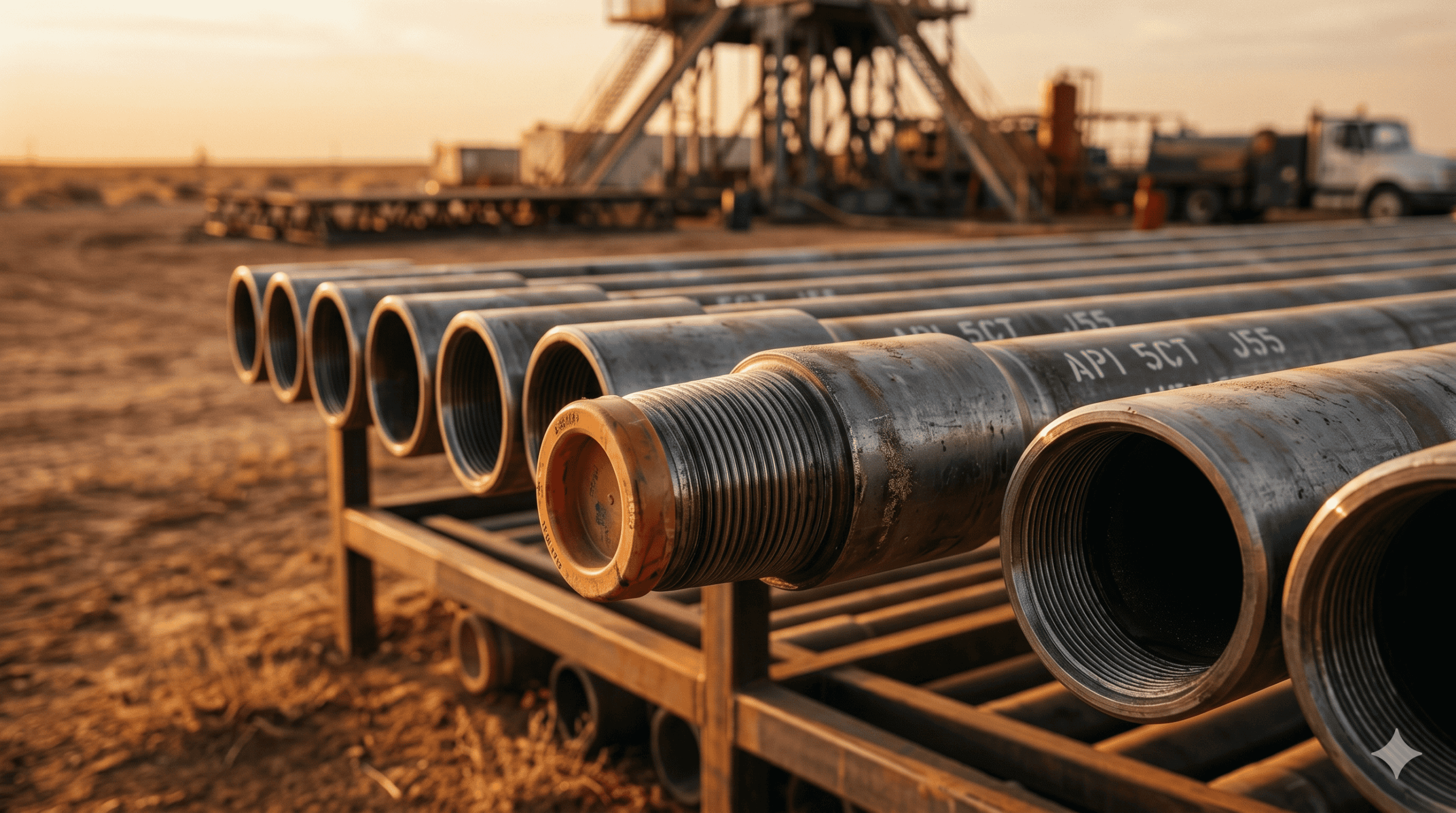
Casing vs. Tubing: Functional Distinction
While both are classified as OCTG and governed by API 5CT, casing and production tubing serve fundamentally different engineering functions and must never be conflated during well design or procurement.
Casing: Structural Wellbore Integrity
Casing is cemented in place within the drilled hole. Its primary functions are to prevent borehole collapse, isolate pressurized formation zones (including H2S- or CO2-bearing strata) from adjacent formations and the surface, and provide a pressure-containing conduit from the reservoir to the wellhead. Multiple concentric casing strings — conductor, surface, intermediate, and production casing — are run sequentially, each requiring precise collapse pressure and burst pressure ratings commensurate with the depth and formation pressure gradients at that section.
Production Tubing: The Production Conduit
Production tubing is installed inside the casing, suspended from the wellhead tubing hanger, and serves as the primary conduit for reservoir fluids (hydrocarbons, brine, or gas) flowing to surface during production operations. Unlike casing, tubing must accommodate continuous fluid flow, thermal cycling, and corrosive downhole environments over the well's producing life. This dynamic service environment demands premium connections, precise internal surface finish, and appropriate grade selection for the produced fluid composition — particularly in the presence of hydrogen sulfide (H2S), which introduces sulfide stress cracking (SSC) risk.
API 5CT Grade Classification: Groups 1 Through 4
API 5CT organizes steel grades into four manufacturing and application groups, each defined by yield strength range, heat treatment process, and intended service environment. Understanding this classification is essential for accurate material specification on well construction AFEs.
Normalized or as-rolled. Economical solution for shallow, low-pressure, non-corrosive wells. Casing and tubing applications.
Quench and tempered (Q&T). Restricted hardness (max 23 HRC for L80). Mandatory for H2S-containing wells per NACE MR0175.
N80 Type 1 is normalized; N80Q is quenched and tempered. Higher yield than J55/K55 for moderate-depth applications.
Q&T. High yield strength for deep, high-pressure wells. P110 is the most widely specified grade in deepwater and HPHT completions.
The following table provides a side-by-side comparison of the five most commonly specified API 5CT grades, with mechanical properties sourced directly from API 5CT, 10th Edition. Procurement engineers should reference these values as minimum thresholds; actual MTRs must meet or exceed these figures.
| Grade | Min. Yield Strength (psi) | Min. Tensile Strength (psi) | Best Application |
|---|---|---|---|
| J55 | 55,000 | 75,000 |
Shallow Wells
Low-Pressure
Non-Corrosive
Standard casing and tubing for onshore vertical wells with benign formation fluids. Cost-effective for conductor and surface casing strings. |
| K55 | 55,000 | 95,000 |
Casing Only
Higher Tensile Load
Preferred over J55 where higher tensile capacity is required (e.g., long casing strings with elevated hanging weight). Same yield as J55 but substantially higher minimum tensile strength. |
| L80 | 80,000 | 95,000 |
Sour Service (H2S)
CO2 Environments
NACE MR0175
Quenched and tempered with controlled max hardness (HRC 23). The primary API 5CT sour service grade. Mandatory when H2S partial pressure exceeds threshold. Available in 9Cr and 13Cr alloy variants for CO2/Cl- corrosion resistance. |
| N80 | 80,000 | 100,000 |
Medium-Depth Wells
General Service
Widely used intermediate-strength grade for non-sour applications. N80Q (quenched and tempered) offers improved toughness. Suitable for production casing and tubing in moderate-pressure wells lacking significant H2S. |
| P110 | 110,000 | 125,000 |
Deep Wells
HPHT
Deepwater
High Collapse
The industry standard for deep, high-pressure / high-temperature (HPHT) wells. Provides exceptional collapse pressure resistance for deep production casing. NOT suitable for sour service without special corrosion-resistant alloy (CRA) processing. |
Table 1 — API 5CT OCTG Mechanical Property Minimums (Source: API 5CT, 10th Edition). All values represent minimum requirements; maximum yield strengths also apply per grade.
When evaluating your well design, cross-reference the minimum yield strength with calculated collapse pressure at total depth (TD) and ensure the selected grade's collapse rating under API 5C3 formulas (or ISO 10400) provides an adequate safety margin — typically a design factor of 1.0 to 1.125 against anticipated external pressures during cementing and after cement curing.
For downstream procurement teams, browsing the OCTG & Pipeline Catalog provides full dimensional data, weight-per-foot ranges, and available connection types (short round thread STC, long round thread LTC, buttress thread BTC, and premium VAM-class connections) for each API 5CT grade.

Wellhead System Integration & Valve Compatibility
The interface between the downhole tubing string and surface production infrastructure is the wellhead — one of the most pressure-critical assemblies in any producing well. The production tubing string terminates at a tubing hanger, which is landed and locked within the tubing head spool of the wellhead. From this point, produced fluids enter the Christmas tree (X-mas tree) valve assembly before being directed to the production manifold or flowline.
For well integrity to be maintained from reservoir to separator, every component in this surface stack must be pressure-rated to at minimum the shut-in tubing head pressure (SITHP) — which in HPHT completions can exceed 10,000 psi. This makes the selection of high-pressure Wellhead Valves an engineering requirement, not a procurement preference.
Gate Valves and Choke Valves in OCTG Systems
API-rated gate valves (conforming to API 6A) are universally deployed on the master valve and wing valve positions of the Christmas tree, providing fully open / fully closed isolation of wellbore pressure. For P110-cased HPHT wells, 10,000 or 15,000 psi API 6A gate valves with Inconel-overlay seats and SS316 trim are the standard specification.
Choke valves (adjustable and positive choke) control the well's production rate and manage drawdown pressure. In wells with corrosive or erosive produced fluids — common in L80 sour service completions — tungsten carbide trim chokes with H2S-rated stem seals are mandatory.
Pipe Valve Global supplies API 6A-compliant wellhead valves — including gate valves, choke valves, and kill/choke manifold assemblies — rated from 2,000 psi to 15,000 psi working pressure, ensuring full system compatibility with any API 5CT OCTG grade deployed downhole.

Quality Control, NDT, and Material Test Reports (MTRs)
In upstream oil and gas procurement, the phrase "API-compliant" carries legal, engineering, and financial weight only when it is supported by a verifiable, unbroken chain of material traceability. At Pipe Valve Global, every batch of OCTG casing and tubing supplied to customers is accompanied by a complete documentation package that begins at the steel mill and follows the product through every stage of manufacture, inspection, and delivery.
Material Test Reports (MTRs): Non-Negotiable Documentation
Every API 5CT OCTG product dispatched by Pipe Valve Global is furnished with full Material Test Reports (MTRs) — also referred to as Mill Test Certificates (MTCs) — that certify:
- Chemical composition (heat analysis and product analysis), including carbon equivalent and sulfur/phosphorus content critical to sour service grades
- Mechanical property test results: actual yield strength, tensile strength, elongation, and Charpy impact energy where applicable
- Heat treatment records for Q&T grades (L80, P110, C90, T95)
- Dimensional inspection reports: OD, wall thickness, weight per foot, drift diameter
- Hardness test results for sour service grades, confirming compliance with the HRC 23 maximum for L80
Non-Destructive Testing (NDT) Protocols
All OCTG products are subject to mandatory non-destructive testing (NDT) per API 5CT and applicable customer supplemental requirements (SR). Standard NDT protocols employed include:
- Electromagnetic Inspection (EMI) — Full-body inspection for longitudinal, transverse, and oblique defects
- Ultrasonic Testing (UT) — Wall thickness measurement and weld seam inspection (for ERW/HFW pipe) or body inspection (for seamless OCTG)
- Hydrostatic pressure testing — Each joint is tested to the API 5CT-specified test pressure for the grade, size, and weight combination
- Drift testing — Mandatory for all casing and tubing to confirm unobstructed bore for downhole tool passage
For technical specifications, certification samples, or to discuss supplemental requirements (SR13, SR15, SR16, etc.) applicable to your specific well design, contact Pipe Valve Global's technical sales team directly via Request a Quote.
Conclusion: Making Informed API 5CT OCTG Decisions
Selecting the right API 5CT OCTG grade requires an integrated understanding of wellbore mechanics, formation fluid chemistry, downhole temperature and pressure profiles, and surface equipment compatibility. The wrong grade — whether over-engineered for economics or under-engineered for well integrity — results in either unnecessary capital expenditure or catastrophic well integrity failures that carry operational, environmental, and reputational consequences.
The grade matrix is clear: J55/K55 for shallow, benign-environment wells; L80 for any application involving sour service or corrosive fluids; N80 for general intermediate-depth applications; and P110 for deep, high-pressure, non-sour HPHT completions. Each of these grades, properly specified and supported by full API 5CT-compliant MTRs, represents a proven engineering solution with decades of global field validation.
Qi Sheng combines the technical capability to supply API-monogrammed OCTG casing and tubing across all grades and sizes with a global logistics network built for upstream project timelines. From single well packages to multi-well program bulk orders, our procurement team works directly with your drilling and completions engineers to match product specification to well design.
B2B Procurement — API-Certified OCTG Supply
Request API 5CT Specifications
& Bulk Quotes
Submit your well design parameters and receive grade-specific technical datasheets, MTR samples, and a competitive bulk pricing proposal within 24 hours.
API 5CT | API 6A | ISO 11960 | NACE MR0175 | Full MTR Documentation Included